Reverse osmosis (RO) is one of the most effective point-of-use technologies for reducing dissolved solids, heavy metals, and many chemical contaminants in drinking water. Understanding how it works helps you choose, install, and maintain a system that delivers reliable, great-tasting water.
This guide explains RO step-by-step, describes key components, highlights typical installation and maintenance tasks, and helps you pick the right system for your household needs.
What reverse osmosis is and why it works
Reverse osmosis forces water through a dense semipermeable membrane that rejects most dissolved salts, organics, and particles. The membrane pores are extremely small — typically around 0.0001 microns — so only water molecules and a few very small compounds pass through. That’s why RO is used where low total dissolved solids (TDS) or high purity is desired, such as for kitchens or labs.
RO systems come in different formats, from dedicated under-sink units to portable countertop models. If you’re considering a home system, compare options like under-sink systems and the space, flow, and maintenance trade-offs they bring: Under-Sink Reverse Osmosis Systems.
Key components of an RO system
An RO system is more than the membrane. Typical components include:
- Pre-filters (sediment and activated carbon) to protect the membrane and remove chlorine, sediment, and organics.
- The RO membrane itself, which provides the main contaminant rejection.
- Post-filters for final polishing and taste improvement.
- A storage tank to hold treated water so you have flow on demand.
- Valves, tubing, fittings, and a dedicated faucet.
Storage tanks are a critical part of many systems because membrane output is low by design; see categories of tanks when matching capacity to household demand: Reverse Osmosis Storage Tanks.
Step-by-step: how RO filters your water
RO filtration happens in stages. A typical sequence is:
- 1) Sediment pre-filter removes sand, rust, and large particles that would foul later stages.
- 2) Carbon pre-filter reduces chlorine and organics that damage the RO membrane and cause taste and odor problems.
- 3) Reverse osmosis membrane rejects dissolved ions, many heavy metals, nitrates, fluoride (to varying degrees), and a large proportion of other contaminants.
- 4) A post-carbon filter (polishing filter) removes remaining tastes and odors and carries out last-stage polishing before the water reaches the faucet.
Many systems are modular and rely on replaceable parts and cartridges. When comparing systems, check the availability of replacement parts and filters to keep performance consistent: Reverse Osmosis System Parts.
Storage tanks and flow: what you need to know
Because RO membranes produce clean water slowly, most systems store the product water in a pressurized tank. Tank size determines how much fresh water is immediately available at the faucet and how often the membrane must run to refill the tank. If the tank bladder or pressure fails, flow stops even if the membrane is fine.
If you prefer a durable option or are replacing an old tank, specific storage tank models can simplify installation and increase longevity—consider a tank designed for RO systems: Neo-Pure Reverse Osmosis Storage Tank.
Installation basics and plumbing connections
Installing an RO system requires basic plumbing: a cold-water feed shutoff, a drain saddle for wastewater, a faucet hole or adapter on the sink, and tubing/fittings to connect components. Most installs use 1/4″ OD tubing and quick-connect fittings for a clean, tool-light setup.
Quality connectors and matching tubing sizes reduce leaks and make maintenance easier—look for appropriate connector kits and parts when installing or upgrading: Water Filter Connectors.
Integrating RO with appliances and dispensers
RO-treated water can feed refrigerator ice makers, refrigerators with water dispensers, or dedicated water dispensers, but you must use the correct tubing and fittings designed for RO pressure and water quality. Some refrigerators require an RO-to-fridge line kit that includes compatible tubing and quick-connect fittings.
If you plan to plumb the RO to an appliance, use a manufacturer-recommended line kit to ensure compatibility and leak-free connections: Refrigerator Water Line Kit.
Maintenance: filters, membranes, and common problems
Routine maintenance keeps RO performance steady. Replace sediment and carbon pre-filters typically every 6–12 months, and RO membranes every 2–5 years depending on feed water quality and system usage. Post-filters usually change annually. Symptoms of maintenance needs include reduced tank fill, lower flow at the faucet, or a change in taste.
Installation accessories like mounting brackets and support hardware make service easier and extend component life in tight spaces beneath the sink: Water Filter Mounting Brackets.
Choosing the right RO system for your home
Decide based on space, water demand, and water quality. Under-sink systems are common for permanent installation and higher flow to a dedicated faucet, while countertop RO systems offer portability and easier setup without cutting into cabinetry.
If portability or non-invasive installation is a priority, evaluate countertop options that deliver RO performance with minimal plumbing: Countertop Reverse Osmosis Systems.
Quick checklist before buying or installing an RO
- Test your source water (TDS, chlorine, hardness, nitrates) to pick the right pre-filters and membrane.
- Decide between under-sink vs countertop based on space and permanence.
- Match storage tank capacity to household demand.
- Plan plumbing connections and order correct connectors and line kits.
- Budget for annual filter replacements and occasional membrane replacement.
FAQ
- Does RO remove chlorine? Not directly—carbon pre-filters upstream of the membrane remove chlorine to protect the membrane and improve taste.
- How much wastewater does RO produce? Ratios vary by design; many residential units are 2:1 to 4:1 (waste:product). Higher-efficiency and tankless models reduce waste but can cost more.
- Do I need a storage tank? For most under-sink systems, yes—tanks provide reasonable faucet flow. Tankless systems exist for higher-throughput setups but often increase cost.
- How often should filters be changed? Pre- and post-filters: typically every 6–12 months. Membrane: every 2–5 years depending on feed water and usage.
- Can I connect RO water to my fridge? Yes, if you use compatible tubing and fittings designed for RO pressure and ensure the fridge manufacturer allows external water connections.
Practical takeaway: match system type (under-sink vs countertop), tank size, and replacement-part availability to your water quality and household demand. Plan installation details—connectors, tubing, and mounting hardware—upfront to avoid surprises during setup.
Products Featured in This Article
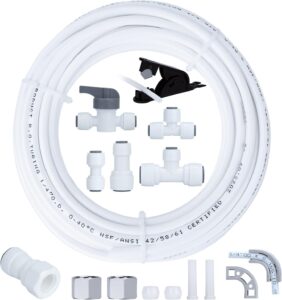
Refrigerator Water Line Kit –…
Product description Compliant with NSF Certification ro tubing 1/4 In O.D. 25 FT compliant with NSF…
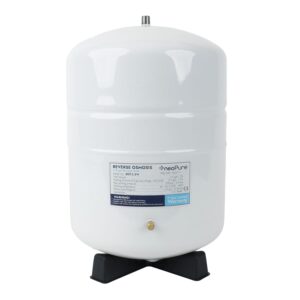
Neo-Pure Reverse Osmosis Storage Ta…
Product description RO Tanks Neo-Pure Stainless Steel Tanks How To Choose The Right RO Tank neoPure…